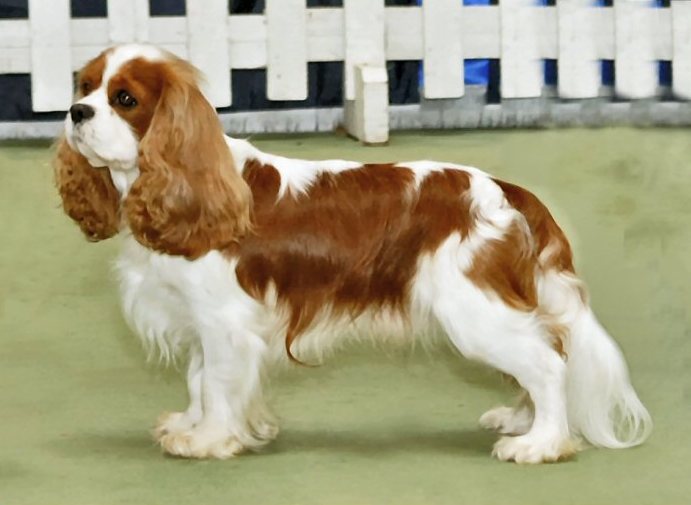
England's lap dog of royalty since the 1600s. Cavaliers are universally friendly, gentle with children, easy to train, and one of the best therapy-dog breeds. The breed-defining tragedy: rampant heart disease (mitral valve disease) means most Cavaliers begin showing heart symptoms by age 5-7.
Mitral valve disease — the breed's defining issue
Mitral valve disease (MVD) is the #1 cause of death in Cavaliers. The mitral valve in the heart degenerates, leaks, and eventually causes congestive heart failure. The numbers are stark: ~50% of Cavaliers have a detectable heart murmur by age 5, ~100% by age 10. This is the worst inherited heart disease in any popular breed. Mitigations: buy from breeders who follow the MVD breeding protocol (parents must be murmur-free at age 2.5+ and grandparents murmur-free at 5+), do annual cardiac auscultation starting at age 3, switch to a board-certified cardiologist for echocardiograms at the first murmur. Pimobendan (Vetmedin) extends life by 12-15 months once symptoms appear. Some Cavalier lines from carefully-tracked breeders (UK and Sweden) have meaningfully delayed MVD onset.
Syringomyelia — the painful brain condition
Syringomyelia (SM) is a brain malformation where the skull is too small for the brain (Chiari-like malformation), causing fluid-filled cavities in the spinal cord and chronic pain. Symptoms: 'air scratching' at the neck/shoulder without contact, head tilting, yelping during walks, sensitivity to neck handling, sometimes seizures. SM affects roughly 50% of Cavaliers by some MRI studies. There's a known genetic risk; responsible breeders MRI-screen breeding dogs. Treatments: gabapentin/pregabalin for pain, NSAIDs, sometimes surgery (cranial expansion). Pet insurance with neurological coverage is critical. If your Cavalier scratches at the neck phantom-style, get a neurologist consult ASAP.
The two Cavalier lines — show vs sport
Most US Cavaliers come from show breeders. UK Cavaliers from sport/working homes (some are still used for casual flushing) tend to be slightly longer-muzzled and have somewhat better cardiac genetics. Buy from breeders who: (1) MRI-screen parents for SM, (2) cardio-screen parents annually, (3) participate in breed surveys (e.g., the Cavalier Health Foundation), (4) have produced at least one parent who lived past 10. A well-bred Cavalier from health-tested parents costs $3-5K but the lifetime savings on cardiac and neurological care are substantial.
Park behavior — universally lovely
Cavaliers are dream dog-park dogs in temperament. They're gentle, sociable, easy with kids, calm with rough play, friendly with strange dogs and humans. Their issue is fragility, not behavior: small bones break easily under rough play with bigger dogs, their feathered coats catch on brush and burrs, and they overheat in summer despite small size. Park strategy: small-dog area only, brief sessions in heat, beach/splash-pad fun is great (most love water), avoid wooded trails with thick underbrush. They make excellent therapy dogs once they pass AKC Canine Good Citizen — many Cavaliers visit hospitals and senior homes professionally.
Coat care — moderate but constant
Cavalier coats are medium-length, silky, with feathering on ears, legs, and tail. Routine: brush 3-4x/week (slicker plus comb), professional groom every 8-12 weeks (sanitary trim, ear cleaning, nail trim), bath every 4-6 weeks. Ear infections are common (long heavy ears trap moisture); weekly ear check + cleaner is mandatory. Light tear staining is normal in Blenheims (the chestnut-and-white color). Avoid heavy grooming products; their skin is sensitive.
What to look for in a park
- Dog parks with small-dog areas
Separate areas just for small breeds — safer play for under-25-lb dogs.
- Dog parks with shade
Parks with mature trees, shade structures, or covered areas to keep dogs cool.
- Indoor dog parks
Climate-controlled indoor dog parks — perfect for rainy days, summer heat, and winter snow.
Owner park rules of thumb
- • Small-dog area only — fragile build for rough play
- • Brief sessions, especially in summer
- • Splash pads and shallow water (most love it)
- • Indoor daycares are excellent in heat or cold
- • Avoid: rough wrestling with larger dogs
- • Best partners: therapy-dog-friendly community parks
Top-matching parks for a Cavalier King Charles Spaniel
Real parks from our directory that score highest for the features your Cavalier King Charles Spaniel needs.


Common health issues to watch for
- Mitral valve disease (MVD — affects ~50% by age 5, ~100% by age 10)
- Syringomyelia (SM)
- Eye disease
- Hip dysplasia
- Episodic Falling Syndrome
Definitions in our breed glossary. Always consult your vet. Save the closest 24/7 emergency vet to your phone.
Similar to Cavalier King Charles Spaniel
Breeds with comparable size, energy, and group classification.






Cavalier King Charles Spaniels appear in these rankings
Frequently asked questions
How long do Cavalier King Charles Spaniels live?+
Cavalier King Charles Spaniels typically live 9-14 years. Keeping any dog at a healthy weight throughout life is the single biggest factor under your control for maximizing lifespan.
How much exercise does a Cavalier King Charles Spaniel need per day?+
Cavalier King Charles Spaniels need 30-60 minutes of daily exercise. Their energy level is moderate. Under-exercised Cavalier King Charles Spaniels can develop destructive behaviors — match their needs to your schedule before adopting.
Are Cavalier King Charles Spaniels good with children?+
Yes — Cavalier King Charles Spaniels are typically good with children when properly socialized from puppyhood. Always supervise interactions between any breed and young kids, and teach kids gentle handling. Individual temperament varies.
Are Cavalier King Charles Spaniels easy to train?+
Yes — Cavalier King Charles Spaniels are highly trainable and generally pick up new commands quickly. They thrive on positive reinforcement (rewards, praise) and respond well to consistent training routines.
Where did the Cavalier King Charles Spaniel come from?+
The Cavalier King Charles Spaniel originated in England (Restoration courts of Charles II). Understanding a breed's original purpose helps explain its modern temperament and exercise needs.
📋 Free Cavalier King Charles Spaniel starter checklist
What to bring, what to watch for, and what to expect at the park with a Cavalier King Charles Spaniel.