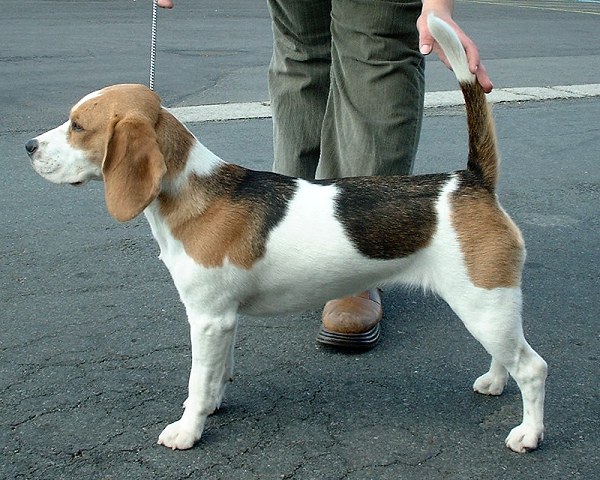
Beagles follow their nose anywhere — fenced parks only, never trust off-leash on open trails. Bay (loud sustained howl) when excited. Famously food-driven, which makes training easy IF you control treats.
The nose is the operating system
Beagles have ~225 million olfactory receptors (humans have ~5 million). They were bred for centuries to track rabbit and hare scent over miles of varied terrain — and that genetic specialty completely overrides everything else when activated. The moment a Beagle locks onto a scent, your voice, your treats, your panicked screaming all stop existing. They are world-class scent dogs (TSA, USDA, and customs use Beagles in airport detection programs) but that exact gift makes them unsuitable for off-leash anywhere. Plan accordingly: fenced parks only, 6+ ft fences (Beagles can climb), long-lines for hikes. NEVER off-leash on open trails — most Beagle losses happen when an over-confident owner thought 'just this once.' Lost Beagles are typically found 3-15 miles away following deer trails.
The bay — the loudest dog you'll ever own
Beagles don't bark; they BAY. The bay is a sustained, high-pitched, throaty howl that can reach 90+ decibels and carry across multiple city blocks. It's how the breed signals to the rest of the pack that they've found scent. Modern apartment-living Beagles bay when: excited (mailman, doorbell, squirrels), bored (left alone too long), uncomfortable (separation anxiety, urgent need to go out), or just because (no apparent reason). Mitigations: extensive crate training, never leave alone for 8+ hours, give them a scent job (find-it games with hidden treats), enroll in nose-work/scent-work classes (the breed dominates this sport). If you're in an apartment with thin walls, this is probably not the breed for you. Bayed-out Beagles get noise complaints filed within their first month.
Beagle obesity — even worse than Labs
Beagles have one of the highest obesity rates among popular breeds. They're driven by their nose, and their nose is constantly hunting for food. They will literally sit by your kitchen for hours waiting for crumbs to fall. Combine that with relatively short legs / compact body and weight piles on fast. Strict food management is non-negotiable: weigh portions on a kitchen scale, NO free-feeding, replace 50% of treats with green beans or carrots, food puzzles to slow eating, securely lock all human food (Beagles have been known to open cabinets and eat 3 lbs of chocolate). Overweight Beagles develop premature joint problems and IVDD (yes, the back is shorter than you think). Keep them at the BCS 4-5 'I can feel ribs through a thin layer' standard.
The scent-game lifestyle
A Beagle without a scent outlet is a destructive, baying, bored dog. Best activities: (1) AKC Scent Work — official sport, your Beagle will love it, (2) Tracking — formal AKC tracking trials, the breed's home turf, (3) Nosework classes at local training facilities, (4) Find-it games at home (hide treats in 12 different spots, send the dog to find), (5) Snuffle mats (Beagles spend hours nose-working a snuffle mat for breakfast), (6) Dog-walks treated as 'sniff walks' rather than power walks — let the Beagle stop and process every bush. Even a basic indoor 'find the kibble' routine 2-3x/day satisfies most pet Beagles. The breed is wired for nose-work the way Border Collies are wired for herding.
Beagle health and the rescue path
Beagles are generally healthy and long-lived (12-15 years). Watch for: ear infections (long ears trap moisture — weekly check + clean), Beagle Pain Syndrome (rare but breed-specific autoimmune condition causing neck pain), epilepsy (some lines carry it; ask breeder), Lafora disease in older Beagles (genetic test exists). Beagle rescue is a major American shelter category — laboratory-research Beagles are released in waves to rescue groups (the breed's docile, easy-handling nature unfortunately makes them a research breed of choice). Many rescued lab Beagles have never seen grass, walked on a leash, or been outside. They make wonderful pets but need patience and house-training help. Organizations: Beagle Freedom Project, BREW (Beagle Rescue Education and Welfare), BFFB, local hunting Beagle rescues.
What to look for in a park
- Fully fenced dog parks
Fully enclosed dog parks with secure perimeter fencing — peace of mind for runners.
- Dog parks with water fountains
Parks with on-site water fountains or dog-friendly drinking stations.
- Dog parks with shade
Parks with mature trees, shade structures, or covered areas to keep dogs cool.
- Dog parks with small-dog areas
Separate areas just for small breeds — safer play for under-25-lb dogs.
Owner park rules of thumb
- • Fully fenced parks ONLY — 6+ ft fence
- • Scent enrichment areas (woody, varied terrain)
- • Avoid: open off-leash trails (recall is unreliable)
- • Avoid: parks with chocolate / human food on ground
- • Long-line hiking on quiet trails works well
- • Best partners: parks with nose-work / tracking clubs
Top-matching parks for a Beagle
Real parks from our directory that score highest for the features your Beagle needs.


Common health issues to watch for
- Obesity
- Ear infections
- Hypothyroidism
- Glaucoma
Definitions in our breed glossary. Always consult your vet. Save the closest 24/7 emergency vet to your phone.
Similar to Beagle
Breeds with comparable size, energy, and group classification.



Beagles appear in these rankings
Frequently asked questions
How long do Beagles live?+
Beagles typically live 12-15 years. Keeping any dog at a healthy weight throughout life is the single biggest factor under your control for maximizing lifespan.
How much exercise does a Beagle need per day?+
Beagles need 60-90 minutes of daily exercise. Their energy level is high. Under-exercised Beagles can develop destructive behaviors — match their needs to your schedule before adopting.
Are Beagles good with children?+
Yes — Beagles are typically good with children when properly socialized from puppyhood. Always supervise interactions between any breed and young kids, and teach kids gentle handling. Individual temperament varies.
Where did the Beagle come from?+
The Beagle originated in England. Understanding a breed's original purpose helps explain its modern temperament and exercise needs.
📋 Free Beagle starter checklist
What to bring, what to watch for, and what to expect at the park with a Beagle.