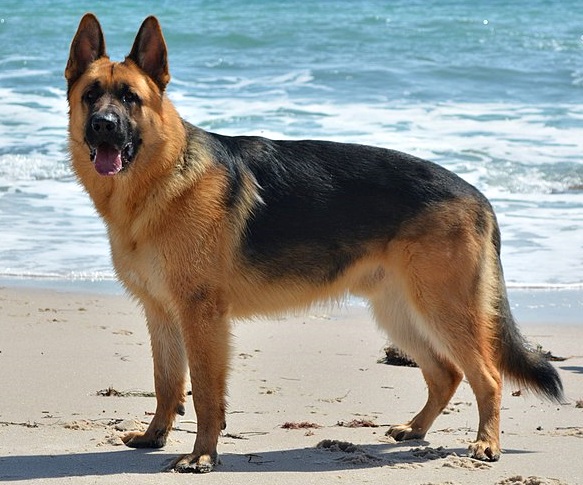
GSDs need space to run and a solid recall. Fully fenced off-leash parks with parking are ideal. Avoid crowded peak hours — they prefer 1-on-1 play. The world's most versatile working breed (police, military, SAR, service).
Working line vs Show line — the most important GSD decision
There are TWO Germans Shepherds in 2026 and they barely look alike. The American Show Line has the iconic sloped back, angled rear, exaggerated topline — bred for the AKC ring, often softer temperament, more health issues. The Working Line (West German, East German DDR, Czech) has a straight back, balanced angulation, intense drive — bred for police, schutzhund, military. Working line GSDs are NOT for first-time owners. They need a job (bite work, herding, scent, or 90+ minutes daily structured exercise). A working-line puppy in a sedentary home will eat your house. If you want a family pet, look for American Show or moderate breeders who select for temperament and lower drive. Ask for the parents' titles — IPO/IGP, BH, AKC CH all matter.
Hip dysplasia & degenerative myelopathy — the two big health issues
Hip dysplasia affects ~20% of GSDs; the sloped back of show lines makes it worse by stressing the rear assembly. Always buy from breeders who PennHIP or OFA test BOTH parents (hips AND elbows, scores Excellent or Good). Degenerative myelopathy (DM) is a progressive spinal cord disease that paralyzes the rear half of the dog over 6-18 months — heartbreaking. DM has a known genetic test (SOD1 gene); responsible breeders test both parents and avoid 'at-risk × at-risk' pairings. Other watchouts: bloat (deep-chested breed — feed 2 small meals, no exercise 1h before/after), exocrine pancreatic insufficiency, and skin allergies.
GSDs are velcro dogs — separation anxiety is real
GSDs were bred for centuries to bond intensely with one handler. That heritage shows up in modern pet GSDs as the 'velcro dog' personality — they want to be with you in every room, often physically touching you. Left alone for 8+ hours regularly, GSDs commonly develop destructive separation anxiety: shredding furniture, drywall, doorframes; vocalizing for hours; self-injury. Mitigations: crate training from puppyhood (cozy, safe space), enrichment toys (Kong frozen, snuffle mats, lickimats), midday dog walker if you work long hours, and slow desensitization to alone time starting at 8 weeks. A GSD with separation anxiety is suffering — address early.
Stranger reactivity — the GSD's biggest park risk
GSDs are protective by selection. The breed standard explicitly calls for 'aloof' temperament toward strangers. In a dog park context, this matters because: (1) some GSDs are reactive to other dogs entering their bubble, (2) most GSDs are uncomfortable being approached by strange humans without their owner's permission. Mitigations: extensive puppy socialization (16+ different dogs per week, 8-16 weeks old), use parks with separate large-dog and quiet hours, NEVER force a GSD into a social situation they're showing stress signals about (lip lick, yawn, tail tuck, hard eye, freeze). A well-socialized GSD is friendly and stable; an under-socialized one is a liability. Skip dog parks entirely if your GSD is reactive — find a backyard playgroup with known dogs instead.
Mental work matters more than physical exercise
A GSD running 3 miles is mildly tired. A GSD doing 30 minutes of structured obedience, scent work, or trick training is exhausted. The breed's intelligence (Stanley Coren ranks them #3) means they need cognitive load. Best activities: tracking (scent work — Cherokee uses scent gloves, Apple uses scent boxes), schutzhund/IGP if you find a club, herding tests (yes, even pets can do herding), advanced trick training, agility, dock diving. Even a 'pet' GSD benefits from 15-20 minutes of training daily. A physically tired but mentally bored GSD is the most destructive dog you'll ever own.
What to look for in a park
- Fully fenced dog parks
Fully enclosed dog parks with secure perimeter fencing — peace of mind for runners.
- Off-leash dog parks
Designated off-leash areas where your dog can run, play, and socialize freely.
- Dog parks with parking
Convenient on-site or adjacent parking — no more circling the block.
- Dog parks with shade
Parks with mature trees, shade structures, or covered areas to keep dogs cool.
Owner park rules of thumb
- • Fully fenced off-leash parks ONLY for play
- • Off-peak hours preferred — they prefer 1-on-1 play
- • Parks with agility equipment for mental stimulation
- • Open trails OK with strong recall + working-line dogs
- • Avoid: crowded peak hours with unfamiliar dogs
- • Avoid: small-dog parks (size mismatch is risky for both)
- • Best partners: parks adjacent to schutzhund/IPO clubs
Top-matching parks for a German Shepherd
Real parks from our directory that score highest for the features your German Shepherd needs.


Common health issues to watch for
- Hip & elbow dysplasia
- Degenerative myelopathy
- Bloat
- EPI
Definitions in our breed glossary. Always consult your vet. Save the closest 24/7 emergency vet to your phone.
Similar to German Shepherd
Breeds with comparable size, energy, and group classification.



German Shepherds appear in these rankings
Frequently asked questions
How long do German Shepherds live?+
German Shepherds typically live 9-13 years. Keeping any dog at a healthy weight throughout life is the single biggest factor under your control for maximizing lifespan.
How much exercise does a German Shepherd need per day?+
German Shepherds need 90-150 minutes of daily exercise. Their energy level is very high. Under-exercised German Shepherds can develop destructive behaviors — match their needs to your schedule before adopting.
Are German Shepherds good with children?+
Yes — German Shepherds are typically good with children when properly socialized from puppyhood. Always supervise interactions between any breed and young kids, and teach kids gentle handling. Individual temperament varies.
Do German Shepherds shed a lot?+
Yes — German Shepherds are heavy shedders, typically with seasonal "blow outs" (3-4 weeks of major undercoat shedding) twice a year. Daily brushing during these periods, weekly otherwise. Robot vacuum strongly recommended.
Are German Shepherds easy to train?+
Yes — German Shepherds are highly trainable and generally pick up new commands quickly. They thrive on positive reinforcement (rewards, praise) and respond well to consistent training routines.
Where did the German Shepherd come from?+
The German Shepherd originated in Germany. Understanding a breed's original purpose helps explain its modern temperament and exercise needs.
📋 Free German Shepherd starter checklist
What to bring, what to watch for, and what to expect at the park with a German Shepherd.